How to Plan a Dedicated Outdoor Cold Plunge Station
September 19, 2026 · 7 min read
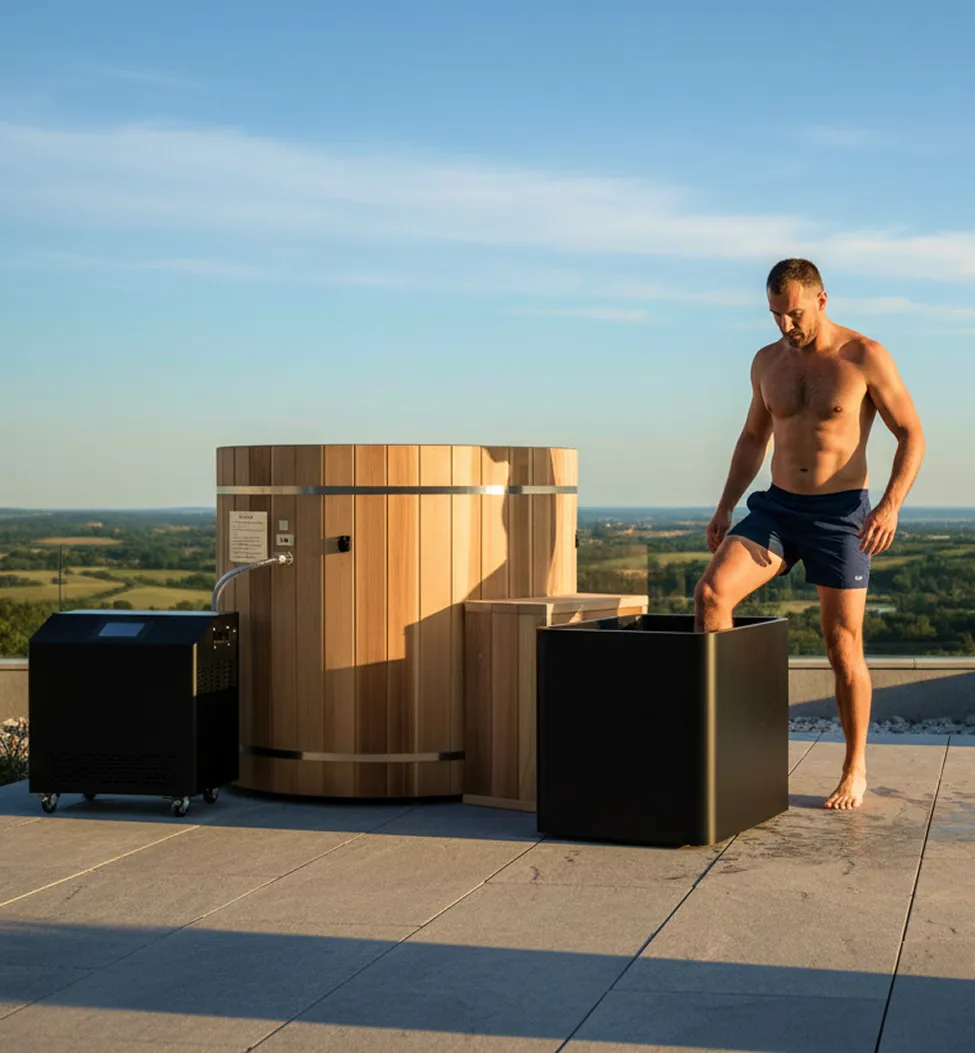
Cold water immersion has transitioned from a niche athletic protocol into a core element of residential backyard design. As fall temperatures drop, dedicated cold plunges become significantly more efficient to operate, but outdoor installations still present specific mechanical challenges. Leaving a residential plunge exposed to freeze-thaw cycles, ambient moisture, and continuous thermal load demands deliberate planning rather than treating the unit like an indoor appliance.
A successful installation balances power delivery, structural load bearing, and accessible sanitization. Whether you are integrating a drop-in plunge into an existing composite deck or installing a standalone insulated stainless steel tub on a hardscape patio, addressing foundation capacity, plumbing connections, and circuit loads early prevents equipment failure and costly retrofits down the road.
Chiller Sizing and Ambient Temperature Realities
A standard cold plunge tub holds between 70 and 110 gallons of water, with an operating target range typically set between 39°F and 50°F. Chiller capacity is rated in horsepower, typically ranging from 1/4 HP for small indoor setups up to 1 HP for heavy-duty exterior units. In outdoor installations, ambient heat gain during sunny afternoons and wind exposure dramatically increase runtime, meaning a 1/4 HP compressor will struggle or run continuously in temperatures above 80°F.
For dependable year-round operation in outdoor environments, select a commercial-grade 1/2 HP or 1 HP chiller equipped with a reversing valve or integrated heating loop. Units with defrost cycles or heating modes protect the internal heat exchanger from cracking during sub-freezing winter weather by preventing the water lines from freezing when the tub is idle. Undersizing the chiller shortens compressor life and leads to frustrating temperature drift between back-to-back sessions.
- 1/4 HP: Suitable only for fully shaded, climate-controlled, or small-capacity residential tubs
- 1/2 HP: Baseline standard for outdoor applications under moderate climate conditions
- 1 HP: Required for rapid pull-down times, heavy daily usage, or unshaded desert/hot-climate yards
Electrical Circuits and GFCI Protection
Most standalone cold plunge chillers operate on a 115-volt, 15-amp or 20-amp supply, but running them on a shared general outdoor circuit is a common failure point. Chiller compressors draw substantial inrush current on startup, which quickly trips shared breakers when outdoor landscape lighting, patio heaters, or pool pumps cycle on simultaneously. Always run a dedicated 20-amp circuit directly from the subpanel to the plunge location.
Because water immersion carries inherent shock hazards, NEC compliance mandates a Class A GFCI-protected outlet housed in an in-use, weatherproof (while-in-use) bubble cover rated for wet locations. Position the receptacle at least five feet away from the edge of the tub to satisfy local electrical codes and eliminate accidental water splashing onto the plug. For hardwired 230-volt chillers, install an exterior non-fused disconnect switch within sight of the equipment pad for immediate servicing.
Subbase Engineering and Weight Calculations
A 90-gallon cold plunge weighs approximately 750 pounds in water alone, plus the tub shell (120 to 250 pounds), the chiller assembly (60 to 90 pounds), and an adult bather (180 to 250 pounds). The total working load easily exceeds 1,200 pounds concentrated over a compact footprint of roughly 15 to 20 square feet, generating a load of 60 to 80 pounds per square foot. Standard residential deck framing is often engineered only for a 40-to-50 PSF total live load and will require structural sistering or additional footings.
If you are placing the plunge at grade, pour a 4-inch-thick, 3,000-PSI wire-reinforced concrete pad over 4 inches of compacted aggregate base. Paver patios are an acceptable surface only if laid over a fully compacted, zero-settlement crushed gravel base; otherwise, the sustained point load will depress pavers and cause pool-water puddling around the tub base.
- Concrete pad: Minimum 4-inch depth with reinforced wire mesh or synthetic fiber
- Deck installations: Verify or retrofit joists to handle minimum 80 to 100 PSF live load
- Equipment footprint: Allow 18 to 24 inches of clear perimeter space for chiller airflow
Drainage Strategies and Water Discharge
While modern chillers run closed-loop filtration, cold plunge water requires full drainage and replacement every four to eight weeks, depending on frequency of use. A 90-gallon discharge dumped directly onto a patio can flood retaining walls, pool decking, or adjacent turf. Plan an intentional gravity drain or hose bib attachment that routes wastewater toward a designated french drain, yard sump, or sanitary sewer access point.
Condensation management is another overlooked drainage factor. When a chiller pulls water temperature down to 42°F on an 85°F day with 60% relative humidity, condensation continuously sweats off the external heat exchanger and uninsulated plumbing lines. Run a dedicated 1/2-inch vinyl drip line from the chiller condensate pan directly into surrounding gravel or planting beds to keep your walking surfaces dry and slip-free.
Filtration, Sanitization, and Water Maintenance
Cold water does not stop bacterial reproduction—it merely slows it down. Without continuous mechanical filtration and active oxidation, skin oils, dead cells, and debris turn standing cold water murky within two weeks. A complete sanitation setup includes a circulation pump cycling the entire volume two to three times per hour through a 20-micron pleated sediment filter.
Chemical sanitization in cold plunges differs from hot tubs because chlorine and bromine dissolve slowly and produce harsh odors in cold water. Most modern exterior plunges utilize an inline ozone generator paired with low-output UV-C irradiation, which neutralizes organic contaminants as water passes through the manifold. Supplement this with food-grade hydrogen peroxide (retained at 50 to 100 PPM) to maintain clear, skin-friendly water without damaging stainless steel internal fittings.
- Filter cleaning: Rinse pleated cartridge weekly; replace every 60 to 90 days
- Ozone / UV-C: Continuous runtime during active 24/7 or 12-hour circulation schedules
- Sanitizer baseline: 34% technical hydrogen peroxide dosed to 50–100 PPM residual
Thermal Insulation and Shell Durability
Thermal loss accounts for more than 75% of a chiller's energy consumption. Uninsulated rotomolded plastic or metal stock tanks will cause chillers to run almost non-stop in the sun, driving up monthly electric bills by $40 to $80. Look for plunge bodies engineered with closed-cell polyurethane foam injected between the interior liner and outer cabinetry, offering an insulation value of at least R-12 to R-18.
Pair the insulated tub with a custom marine-grade, dense foam-core cover that features a tight perimeter taper and locking security latches. The cover prevents convective heat gain in summer, stops ice formation along the surface in deep winter, and blocks windborne leaves from clogging the primary cartridge filter. For coastal zones, ensure the outer cabinet uses 316 marine-grade stainless steel or UV-stabilized high-density polyethylene rather than raw aluminum or untreated cedar.
Shop the parts mentioned
Ready to shop this category?
Thousands of products in stock — pay over time with Shop Pay on items over $50.
Shop cold plunge